Pasta 101
How to cook pasta perfectly al dente every time
The formula
Memorise this once and you never need to look up pasta cooking again:
4 litres of water + 2 tablespoons of salt per 500g pasta. Cook for the time on the pack, minus 1 minute. Taste. Drain. Save a mug of pasta water.
That’s the whole thing. Everything below is just the why behind each step.
What does al dente actually mean?
Al dente translates literally as “to the tooth” — it describes pasta that’s tender on the outside but still has a little resistance in the centre when you bite. Not crunchy. Not raw. Just a pinhead of firm starch in the middle that gives the pasta backbone on the plate.
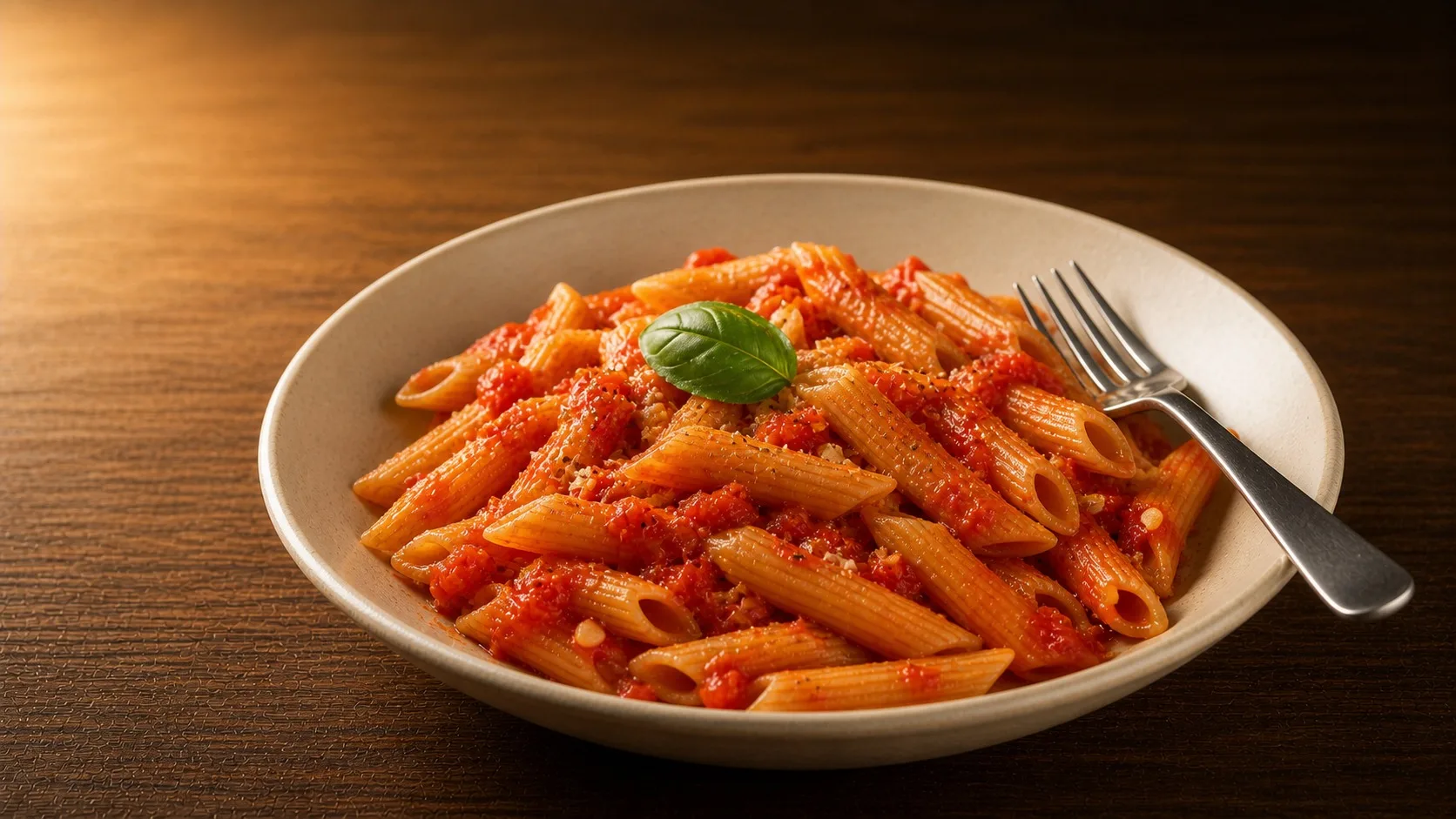
If you cut a piece of cooked penne in half lengthwise, al dente shows up as a tiny pale dot at the core — the rest is one even colour.
Why does this matter?
Two reasons:
- Sauce coating. Al dente pasta still has a slightly firm outer surface, which the sauce clings to. Overcooked pasta develops a sticky outer layer that sauce slides off.
- It keeps cooking after you drain. Pasta in residual heat finishes itself in 30–60 seconds in the sauce. If you wait until it’s perfect in the water, by the time it hits the plate it’s soft.
Use enough water
Four litres for 500g of pasta is the standard. The shapes need room to move, the starch they release needs to dilute, and the temperature mustn’t crash when you drop them in.
If you only have a smaller pot, scale down both the pasta and the water — but keep the ratio. Not sure how much pasta to cook in the first place? See the pasta portion guide or use the interactive portion calculator.
Salt the water generously
Two tablespoons of fine salt for 4 litres. The water should taste like a clear seafood broth — surprisingly salty, but never sea-salty. Underseasoning the water is the single most common mistake; you cannot fix it later by adding salt to the sauce.
Salt does three things:
- Seasons the pasta from the inside as it cooks
- Subtly firms up the gluten network
- Raises the boiling point by a fraction (negligible, but it’s a small bonus)
Bring to a rolling boil before adding the pasta
Drop the pasta into a true rolling boil, not a simmer. If the water is barely bubbling, the pasta will sit at the bottom and stick. Wait the extra 60 seconds.
Stir at the start, then leave it
Stir for the first 30 seconds so nothing clumps. Then leave it alone except for a stir every couple of minutes. There’s no need to add oil — it just makes the cooked pasta slippery so the sauce won’t stick.
Taste one minute before the pack time
The cooking time on every Cibo di Italia pack is the time-to-fully-cooked. For al dente, set your timer for one minute less and taste at that point.
Bite a piece. Look for that tiny pale core in the middle. If it’s there, you’re al dente — drain. If the pale dot is too obvious or crunchy, give it 30 more seconds and taste again.
Save a mug of pasta water before you drain
This is the single tip that levels up home pasta. Before you drain, scoop a mugful of the cloudy, salty pasta water with a heatproof cup. It’s full of dissolved starch, which is the natural emulsifier that turns a thin sauce into a glossy one that clings.
You’ll use 2–4 tablespoons of it when you toss the pasta with the sauce.
Drain without rinsing
Drain in a colander and toss into the warm sauce pan immediately. Rinsing washes off the starches and cools the pasta down — only do it for cold pasta salads.
Finish in the sauce
Toss the drained pasta into the sauce for the final 60–90 seconds of cooking. Add splashes of pasta water as you toss, until the sauce coats every piece without pooling at the bottom.
This is where home pasta and restaurant pasta diverge — that last minute in the pan is what creates the unified, glossy plate.
Quick reference card
| Shape | Pack time | Al dente time |
|---|---|---|
| Macaroni (Classic) | 8–10 min | 7–8 min |
| Fusilli (Classic) | 9–11 min | 8–9 min |
| Penne Rigate (Classic) | 9–11 min | 8–9 min |
| Conchiglie Rigate | 10–12 min | 9–10 min |
| Whole Wheat Penne | 10–12 min | 9–10 min |
| Gluten-Free Penne Rigate | 8–10 min | 7–8 min |
The takeaway
Cooking pasta well isn’t a chef skill — it’s a checklist. Plenty of water. Plenty of salt. A rolling boil. Pack-time minus one minute. Pasta water saved before the drain. Finish in the pan with the sauce. Six rules, every time, and dinner gets noticeably better.
Once you’ve nailed the technique, the next step is choosing the right shape. See which pasta shape pairs with which sauce for the full breakdown across the Cibo di Italia range.
Frequently asked questions
What does al dente mean exactly?
“Al dente” is Italian for “to the tooth.” It means the pasta is cooked through on the outside but retains a small, firm core that gives a little resistance when you bite. It is not crunchy or raw — just not soft all the way through. That tiny pale dot in the middle when you cut a piece in half is the marker you’re looking for.
How long does al dente cooking take?
It depends on the shape. For Cibo di Italia Classic shapes, al dente is typically 1 minute less than the pack time: Macaroni 7–8 min, Fusilli 8–9 min, Penne Rigate 8–9 min, Conchiglie Rigate 9–10 min. Whole Wheat Penne takes 9–10 min. Gluten-Free Penne Rigate is faster — aim for 7–8 min. Always taste 1 minute before the pack time and adjust from there.
How much salt should I add to pasta water?
Use 2 tablespoons (around 20–25g) of fine salt per 4 litres of water. The water should taste noticeably salty — not ocean-salty, but something like a light broth. This is the only chance you have to season the pasta itself; sauce added later cannot compensate for unsalted water.
Should I rinse pasta after draining?
No — not for hot dishes. Rinsing washes away the surface starch that helps sauce cling, and it cools the pasta immediately, which means the sauce won’t meld in the pan. The only time rinsing makes sense is for cold pasta salads, where you want the pasta to stop cooking quickly and cool down before adding dressing.
Is gluten-free pasta cooked the same way?
Yes, the method is identical — same water ratio, same salt, same taste-first approach. The main difference is timing: Cibo di Italia Gluten-Free Penne Rigate cooks in 8–10 minutes (al dente at 7–8 min). Watch it more closely near the end because gluten-free pasta can go from al dente to soft quickly. Also avoid leaving it in hot water after cooking — drain promptly and finish in the sauce right away.