Pasta 101
How much pasta per person? A guide to portion sizes
The simple answer
As a main course: 80–100g of dry pasta per adult. Lean towards 100g if the sauce is light (a simple tomato or aglio e olio); lean towards 80g if the sauce is rich or chunky (a creamy bake, a ragu).
As a starter or side: 50–60g per adult.
For kids: 50–70g depending on age and appetite.
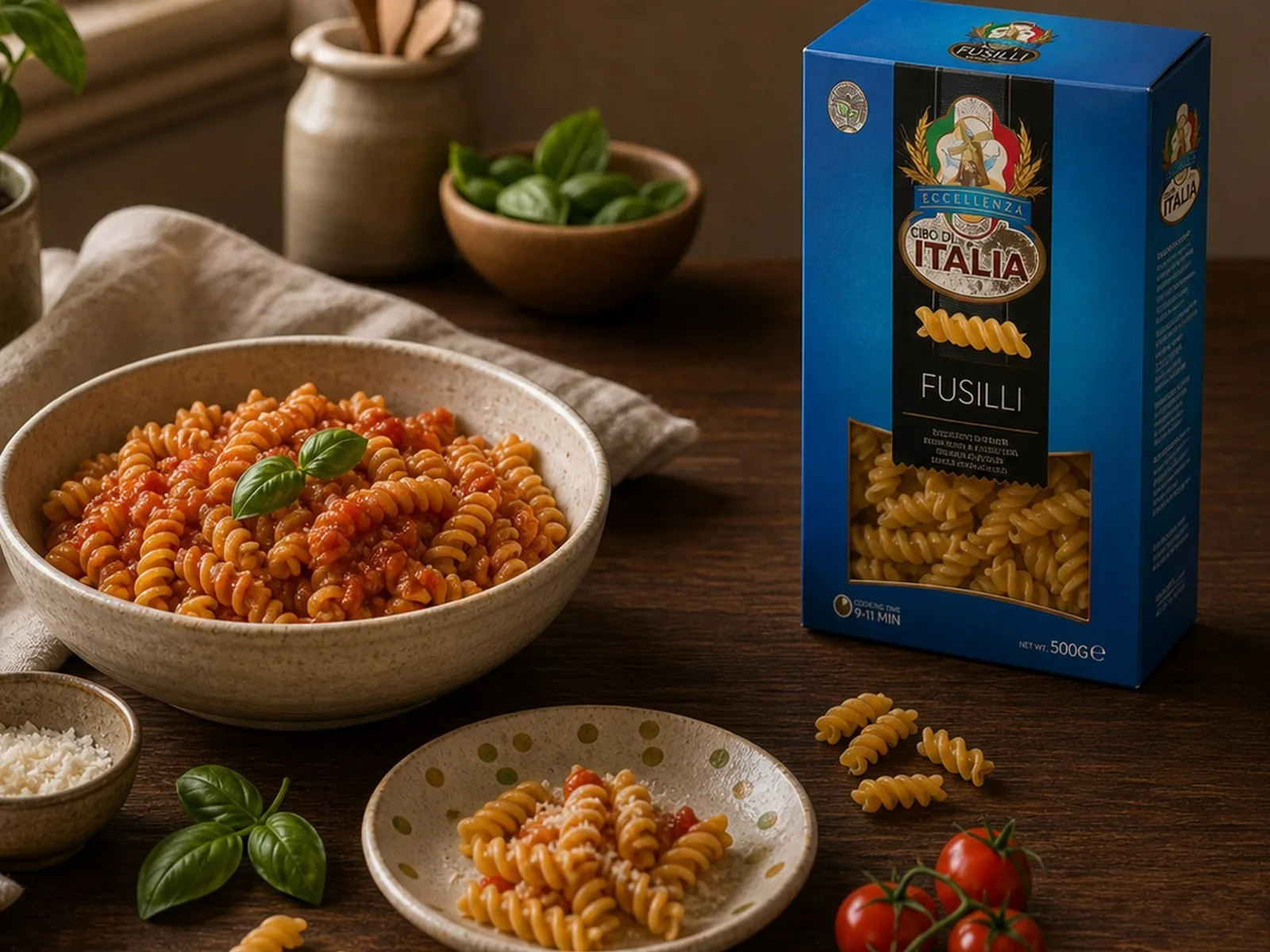
A 500g pack of Cibo di Italia pasta feeds 4–5 adults as a main, or 8–10 as a starter.
Try the portion calculator
Adjust the number of eaters and sauce style below — the calculator handles the maths and tells you how many packs to grab.
Working rule: 80–100g of dry pasta per adult for a main; 50–60g for a starter or side. Heavier sauces eat fuller, so we trim 20g. See the full pasta-101 guide for the reasoning.
Why dry weight, not cooked
Dry pasta nearly doubles in weight as it cooks (the difference is the water it absorbs). Recipe portion guides nearly always refer to dry weight because it’s the only stable measure. A cooked weight depends on how al dente you took it and how much pasta water it drank.
If you have to work backwards from cooked pasta, divide by roughly 2 to get the dry equivalent.
Quick reference chart
| Eaters | Main course | Starter / side |
|---|---|---|
| 1 adult | 80–100g | 50–60g |
| 2 adults | 200g | 120g |
| Family of 4 (2 adults, 2 children) | 320–360g | 200g |
| Family of 4 (4 adults) | 400g | 240g |
| Family of 5 | 500g (one whole pack) | 300g |
| Dinner party of 6 | 500–550g | 360g |
| Big gathering of 10 | 1kg (two packs) | 600g |
Adjusting for the sauce
A sauce-heavy plate eats fuller. Use these reality checks:
- Light tomato or olive oil-based sauce: 100g per adult. People will want a hearty bowl.
- Rich cream or cheese-based sauce: 80g per adult. The sauce adds calories and weight.
- Chunky ragu, sausage, beans, vegetables: 80g per adult. The sauce brings serious volume.
- Pasta salad served cold: 70–80g per adult. People eat less of cold pasta than hot.
- Pasta bake / casserole: 80g per adult — but always check whether the recipe specifies, since baked dishes vary in how much extra goes in.
How to portion without scales
If you don’t have a kitchen scale to hand:
- For short shapes (penne, fusilli, macaroni, conchiglie): one heaped fistful of dry pasta is roughly 80–90g per adult. Two fistfuls feeds two.
- A standard mug holds roughly 110–130g of dry penne or fusilli — useful for a generous single portion.
- A standard 500g pack = 5 hand-sized fistfuls. Count them out the next time you weigh, and you’ll have a permanent reference for your own hand.
Children’s portions, honestly
Children’s appetites range so widely that any chart is approximate. As a rough guide:
- Toddlers (2–3 years): 30–40g
- Younger kids (4–7): 50–60g
- Older kids (8–12): 60–80g
- Teenagers: count as adults, sometimes more
The signal we recommend isn’t the chart, it’s the leftover. Aim to slightly overshoot rather than undershoot — leftover pasta makes an excellent next-day lunchbox or fridge pasta salad.
Adjusting for cuisine and context
A few honest adjustments worth making:
- A Ramadan iftar plate where pasta is one element of a larger spread: 60–70g per adult. People will be sampling many things.
- A weeknight dinner where pasta is the whole meal: 100g per adult. No one walks away hungry.
- A pasta bake for entertaining where you also serve bread, salad and a dessert: 80g per adult is plenty.
- A working-from-home solo lunch: 80g, generously sauced, is satisfying without leaving you sluggish.
What about whole wheat or gluten-free?
Same dry-weight portions. Whole wheat pasta is slightly more filling per gram because of the fibre, so you can sometimes get away with 70–80g for an adult main if the sauce is hearty. Gluten-free pasta portions are identical to wheat — our Gluten-Free range packs the same 500g as Classic, so the serving maths is the same.
Saving leftover dry pasta from the pack
If you cook 320g out of a 500g pack, the remaining 180g keeps in the original pack rolled tightly closed for months. Dry pasta has a long shelf life — see Storing dry pasta: how long does it really last? for the detail.
The takeaway
80–100g per adult for a main, 50–60g for a side. Weigh once, learn your handful, and you’ll never need to measure again. A 500g Cibo di Italia pack is built around the 5-adult main-course portion — pull a single pack for the family and you’re already there.
Once you’ve got portions sorted, the next question is usually technique. See how to cook pasta perfectly al dente and which shape pairs with which sauce to round out the basics.
Frequently asked questions
How much pasta do I need for 2 people?
For two adults having pasta as a main, weigh out 180–200g of dry pasta. For a lighter sauce (tomato, olive oil) use 200g; for something richer (cream, cheese) 160–180g is plenty. A 500g pack covers two adults for two-and-a-half meals.
How much pasta for a family of 4?
For a family of two adults and two children aged 8–12, aim for 320–360g of dry pasta as a main. Four adults need around 380–400g. A single 500g pack is generous for a family of four with a hearty sauce; use the whole pack if the sauce is light or if anyone has a big appetite.
Is pasta measured cooked or dry?
Always weigh dry. Dry pasta is the only stable measure — cooked weight varies depending on how long it simmered and how al dente you took it. As a rough guide, dry pasta roughly doubles in weight once cooked (80g dry becomes about 160g cooked).
How much pasta should I give a child?
A child under 12 needs roughly 50–70g of dry pasta as a main. Toddlers (2–3 years) are fine with 30–40g; kids aged 4–7 around 50–60g; older children (8–12) can manage 60–80g. Teenagers generally eat adult portions. Give slightly more than you think they’ll need — it’s easier to leave pasta on the plate than to re-cook.
Are gluten-free portions the same?
Yes. The dry-weight portions for our Gluten-Free range (chickpea, rice and pea blend) are identical to Classic durum pasta. The only difference worth knowing is that gluten-free pasta tends to firm back up as it cools, so eat it promptly or it can go a little stodgy.